

Burnout vs Depression: How To Tell The Difference

Burnout and depression are two of the most commonly confused states in mental health. Both can leave a person feeling exhausted, unmotivated, and unable to function as they normally would. Both can affect concentration, sleep, and the ability to find pleasure in everyday life. In conversation and in the media, the two terms are often used interchangeably.
They are not the same condition. The distinction matters, because burnout and depression have different causes, different trajectories, and different treatment pathways. Misidentifying one as the other is not simply a semantic issue. It can lead to the wrong kind of support, or no meaningful support at all.
This article sets out the key differences between burnout and clinical depression, where the two overlap, how a clinical assessment helps to clarify the picture, and when it is appropriate to seek professional help.
What Is Burnout?
Burnout is defined by the World Health Organisation as an occupational phenomenon resulting from chronic workplace stress that has not been successfully managed. It is characterised by three core dimensions: a feeling of energy depletion or exhaustion; increased psychological distance from one's work, or feelings of cynicism and negativity related to one's job; and reduced professional efficacy.
Importantly, the WHO classification positions burnout specifically in relation to the occupational context. It is not classified as a medical condition in its own right, but as a factor influencing health status. This distinction is clinically significant. Burnout is understood as a response to an external situation, one that is prolonged, stressful, and insufficiently recovered from. Remove or substantially change the stressor, and the burnout often begins to resolve.
According to Mental Health UK's Burnout Report 2026, 91 per cent of adults in the UK reported high or extreme levels of pressure or stress in the past year, with one in five having taken time off work due to poor mental health caused by pressure or stress. Adults aged 25 to 34 are now the group most likely to report extreme stress levels, a shift from previous years when the 35 to 44 age group led that finding.
Burnout does not arise only in high-pressure corporate environments. It can develop in caregiving roles, in people managing chronic illness, in parents, and in those carrying financial or social responsibilities over long periods without adequate recovery.
What Is Clinical Depression?
Depression, or major depressive disorder (MDD), is a recognised psychiatric condition with a well-established diagnostic framework. It is defined in the Diagnostic and Statistical Manual of Mental Disorders (DSM-5-TR) by a specific constellation of symptoms, present for a minimum of two weeks, that represent a change from previous functioning and cause significant distress or impairment.
The core symptoms of depression include persistent low mood characterised by sadness, emptiness, or hopelessness; and a marked loss of interest or pleasure in activities that were previously enjoyable, a state known clinically as anhedonia. To meet the diagnostic threshold for major depressive disorder, at least five of the following must be present during the same two-week period: depressed mood, anhedonia, significant changes in weight or appetite, sleep disturbance, psychomotor agitation or slowing observable to others, fatigue or loss of energy, feelings of worthlessness or excessive guilt, difficulty thinking, concentrating, or making decisions, and recurrent thoughts of death or suicidal ideation.
Depression does not require an external trigger. It can emerge in the context of a life that appears, from the outside, to be functioning well. This is one of the characteristics that most clearly distinguishes it from burnout.
Where Burnout and Depression Overlap
The symptom overlap between burnout and depression is considerable, and this is what makes self-assessment unreliable.
Both burnout and depression share symptoms including exhaustion, emotional disconnection, reduced motivation, and difficulty coping. Research suggests the two may share a common biological basis, and there is evidence of a positive correlation between burnout and depressive symptoms.
Both conditions can disrupt sleep. Both can impair concentration and decision-making. Both can cause a person to withdraw from social contact. Both frequently present with physical symptoms including fatigue, headaches, and gastrointestinal disturbance. A person experiencing either may describe themselves as feeling low, flat, or unable to cope.
Left unaddressed, burnout can increase the risk of anxiety, depression, and longer-term health problems. In clinical practice, it is not uncommon to see patients who began with occupational burnout and, over time, developed a full depressive episode. The two conditions can coexist, and each can intensify the other.
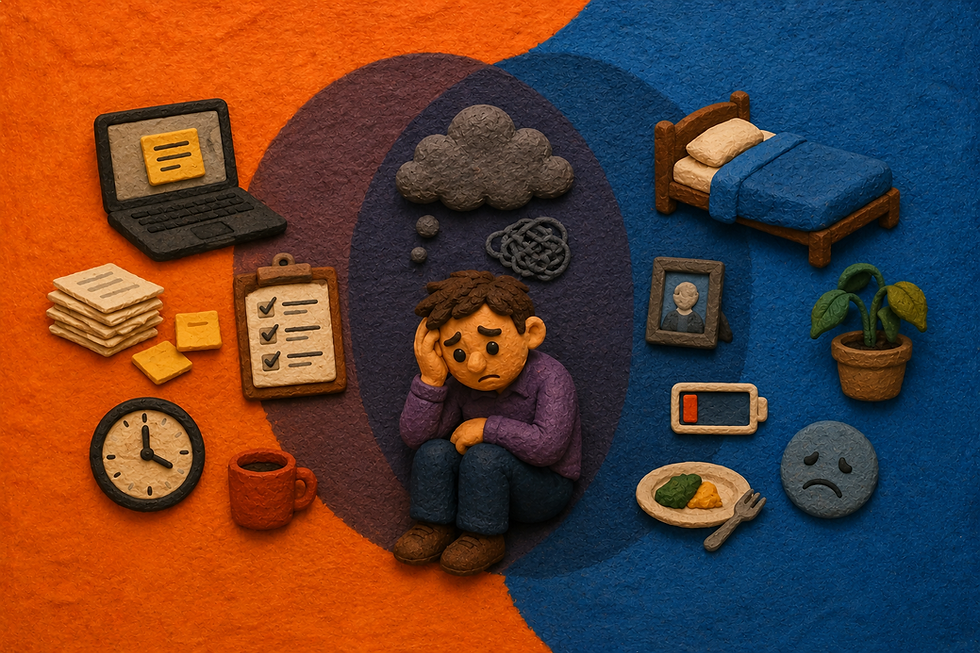
The Key Differences: Burnout vs Depression
Scope of effect
One of the most defining differences between burnout and depression is that burnout is situation-specific and often related to a person's working environment, whilst depression can show up regardless of a person's circumstances and environment.
A person in burnout typically notices that their symptoms are concentrated around their work or primary stressor. They may feel relatively better during periods of rest, on holiday, or when removed from the source of pressure. A person with clinical depression tends to carry their symptoms into all areas of life. Time away does not restore them. Rest does not meaningfully lift the mood. The heaviness follows them.
This is a clinically useful, if not definitive, indicator. If significant time away from work produces a genuine improvement, burnout is more likely. If the same bleakness persists regardless of circumstance, a depressive episode warrants careful consideration.
Anhedonia
One of the hallmark features of clinical depression is anhedonia: the inability to experience pleasure in activities that were previously enjoyable. This is distinct from burnout-related disengagement. A person with burnout may be exhausted and cynical about their work, but can often still find enjoyment in hobbies, relationships, and leisure activities outside of that context. A person with depression frequently finds that even activities they once loved have become flat or meaningless.
Guilt, worthlessness, and self-perception
Clinical depression is often accompanied by a pervasive sense of worthlessness, excessive guilt, or a deeply negative self-concept that is not proportionate to any specific external failure. Burnout can bring self-doubt and reduced confidence, but these feelings tend to be anchored to the work context and the specific stressors involved. In depression, the negative self-evaluation becomes more global and more fixed.
Response to rest
Burnout characteristically improves with adequate rest, reduction in demands, and removal from the source of stress. Depression does not. If a person has taken a substantial period of time away from work or their primary stressor and continues to experience the same level of exhaustion, low mood, and loss of interest, this is an important signal that something beyond burnout may be present.
Suicidal ideation
Suicidal thoughts, or thoughts of death, are not a feature of burnout. They are a recognised symptom of clinical depression. If these thoughts are present, even passively, professional assessment is urgent and should not be deferred.
Can Burnout Cause Depression?
Burnout can turn into clinical depression, particularly if the warning signs are ignored and the person continues to push forward without adequate support or relief from the source of stress.
Prolonged burnout, particularly when accompanied by poor sleep, social withdrawal, and a diminishing sense of identity or purpose, creates conditions in which a depressive episode can take hold. In this sense, untreated burnout is not simply uncomfortable. It carries a meaningful clinical risk.
This is one of the reasons why early identification matters. Addressing burnout before it transitions into depression is considerably more straightforward than treating a fully established depressive episode, particularly one that has become entrenched over time.

Why Self-Diagnosis Is Unreliable
The symptom overlap, the capacity for the two conditions to coexist, and the absence of a clear boundary in many presentations means that self-diagnosis is genuinely unreliable in this area. Many people living with depression identify themselves as burned out, partly because depression carries more stigma, and partly because the depressive episode has arisen in a context of external pressure that makes burnout feel like the more logical explanation.
Equally, people with severe burnout can be inadvertently pushed towards antidepressant medication when what they primarily need is structured rest, boundary-setting, and talking therapy focused on the occupational stressors. A thorough clinical assessment identifies what is actually present, rather than defaulting to what appears most plausible on the surface.
What Assessment Involves
A clinical assessment for burnout vs depression is not a brief questionnaire. At a specialist private mental health clinic, it will typically involve a detailed psychiatric or psychological evaluation exploring the nature, duration, and pattern of symptoms; their relationship to external stressors and life circumstances; the presence of co-occurring conditions such as anxiety, trauma, or ADHD; previous mental health history and response to any prior treatment; and the impact of symptoms on functioning across all domains of life.
This breadth of assessment is important because both burnout and depression frequently coexist with other conditions that can complicate and perpetuate the presentation. Undiagnosed ADHD, for instance, is a relatively common finding in adults presenting with burnout, and significantly changes the recommended treatment approach. Trauma history can underlie what presents as depression. Anxiety can drive the relentless overworking patterns that produce burnout.
A well-structured assessment does not rush to a single label. It seeks to understand the whole picture.
Treatment Approaches
For burnout
Burnout does not have formal clinical practice guidelines in the way that depression does, because it is not classified as a medical condition. That said, effective management of burnout is well understood and typically involves structured reduction of the stressor load; prioritisation of sleep and physical recovery; therapeutic support to address the patterns of thinking and behaviour that contributed to burnout, including perfectionism, difficulty delegating, and boundary difficulties; and, where relevant, practical workplace support or occupational adjustments.
Talking therapies, particularly cognitive behavioural therapy and approaches grounded in Acceptance and Commitment Therapy, are frequently helpful. The focus in burnout treatment is as much on the conditions that produced the exhaustion as it is on the exhaustion itself.

For depression
As a formal diagnosis, major depressive disorder has clinical practice guidelines that provide a framework for treatment, recommending a combination of medications, psychotherapy, and supportive therapies. The goal is to reduce distressing symptoms whilst helping the individual identify and reframe unhelpful patterns of thinking and behaviour.
Antidepressant medication, typically an SSRI as a first-line option, is recommended for moderate to severe depression and is often used alongside psychological therapy. Cognitive behavioural therapy has a strong evidence base for depression. For individuals who have not responded to initial treatments, psychiatric review can identify whether alternative or augmented pharmacological approaches are indicated.
Where both burnout and depression are present, treatment needs to address both dimensions, typically beginning with stabilisation of the depressive episode before focusing on the occupational and structural factors that contributed to it.
When To Seek Professional Support
The following are indicators that a clinical assessment is appropriate rather than optional.
Symptoms have been present for more than two weeks and are not improving with rest. Low mood is present across all areas of life, not only in relation to work or a specific stressor. There is a loss of pleasure in activities that were previously enjoyable. Sleep is significantly disrupted in either direction. There are thoughts of hopelessness about the future, or any thoughts related to death or not wanting to continue. Daily functioning at work, in relationships, or in self-care has declined noticeably. There is uncertainty about what is actually present, and self-assessment has not produced a clear picture.
None of these indicators require certainty before an appointment is made. Uncertainty about whether symptoms are serious enough to warrant help is itself a reason to seek assessment, not a reason to wait.
Burnout and Depression Treatment at Psyche Clinic, Harley Street
Psyche Clinic is a specialist private mental health clinic at 10 Harley Street, London. Our clinical team includes consultant psychiatrists and clinical psychologists with extensive experience in assessing and treating both burnout and depressive disorders, including presentations where the two conditions overlap.
We conduct thorough assessments that explore the full complexity of a person's presentation, identifying what is present, what has contributed to it, and what the most effective treatment pathway looks like. We do not delegate care to junior or trainee staff. Every patient is seen by a senior clinician from the outset.
Appointments are available in person at our Harley Street clinic and via Zoom. We are typically able to offer initial appointments within days rather than weeks. All consultations are conducted with complete confidentiality, and we are recognised by all major private medical insurers.
If you would like to speak with a member of the team before booking, we are available to help you understand the most appropriate pathway for your circumstances.

A Note on Clinical Expertise

Dr Susie Rudge is a Chartered Clinical Psychologist with 20 years of experience working with adults across the NHS, private practice, and academia. Her therapeutic approach draws on Acceptance and Commitment Therapy, Cognitive Behavioural Therapy, and Compassion-Focused Therapy, with a particular focus on mindfulness skills-building where appropriate. She has extensive experience working with depression, anxiety, and adjustment to significant life changes, including the kind of sustained occupational and personal pressures that frequently underlie burnout presentations. When you are seen at Psyche Clinic for either condition, you are in the hands of clinicians for whom this is a core area of practice, not a peripheral one.
Frequently Asked Questions
Can burnout and depression occur at the same time?
Yes. It is entirely possible to present with both. Prolonged burnout can create the conditions in which a depressive episode develops, and the two can then coexist and reinforce one another. A thorough clinical assessment will identify both and inform a treatment approach that addresses each.
Is burnout a mental illness?
Burnout is not classified as a mental illness. The World Health Organisation categorises it as an occupational phenomenon, specifically a state resulting from chronic workplace stress that has not been successfully managed. It is a serious condition that warrants proper attention, but it does not carry a psychiatric diagnosis in the way that major depressive disorder does.
How long does it take to recover from burnout?
Recovery from burnout varies considerably depending on severity, how long it has been present, and the degree to which the underlying stressors can be reduced or modified. Mild to moderate burnout may resolve over several weeks with adequate rest and support. Severe or long-standing burnout can take months. Recovery is also slower where burnout has transitioned into a depressive episode.
Do I need medication for burnout?
Burnout itself is not treated with medication. Where depression has developed alongside burnout, antidepressant medication may be appropriate and will be considered as part of a psychiatric assessment. Medication decisions are always made individually, informed by the full clinical picture, and discussed with the patient before any prescription is made.
How do I access a private assessment for burnout or depression in London?
You can contact Psyche Clinic directly without a GP referral. Our team will discuss your situation, advise on the most appropriate clinician to see, and arrange an appointment at a time that works for you. Assessments are available in person at 10 Harley Street and via Zoom.
Will my private medical insurance cover treatment for depression?
Many private medical insurance policies cover psychiatric assessment and treatment for depression. Psyche Clinic is recognised by all major insurers, including Bupa, Aviva, AXA, Cigna, Vitality, Allianz, and Simplyhealth. We recommend contacting your insurer before your first appointment to confirm your level of cover and any pre-authorisation requirements.
Book an Assessment
If you are concerned that what you are experiencing may be burnout, depression, or both, and you would like a thorough clinical assessment with a senior specialist, Psyche Clinic is here to help.
To book an appointment or make an enquiry, visit psycheclinic.co.uk or contact us at contact@psycheclinic.co.uk or +44 (0) 20 7467 8527.
Appointments are available in person at 10 Harley Street, London W1G 9PF, and via Zoom.


